

In 2026, the reality is that we’re watching insurance companies churn through customers due to poor communications and low engagement rates. But as their insurance company, you can turn the dials. You can meet their need for a trustworthy service provider; you can give them opportunities to engage that they actually want to take.
With decades in the insurance industry, Elixir’s helped companies drive value from their member communications longer than any other customer communications management (CCM) company. Just one example: USAA, an insurer and financial services provider we work with, was struggling to keep up with customer expectations, partly because they relied on mainframe exports instead of real-time data. Now, with Elixir Cloud, USAA can handle real-time comms through every channel for six lines of business — through one platform.
This blog post covers how insurance leaders engage customers in insurance through their customer communications, gleaned from decades in the industry and updated for the modern era of customer experience (CX).
In any kind of insurance, customer retention equals trust plus engagement
Consumers trust insurance companies less today than any other time in the last five years. Meanwhile, NPS scores for insurance companies are slowly crawling back to pre-pandemic levels (some segments faster than others). So if you work at an insurance company and you’re trying to increase customer engagement, you’re probably keenly aware of the relationship between customer trust, engagement, and retention:
-
Trust: Customers need to trust you in order to want to keep engaging. If you want customers to engage — take out new policies, renew existing policies, file claims, use your app, and refer new customers — they need to feel that you’ve got their best interests in mind (and that you’re treating their personal information with that same care).
-
Engagement: When customers choose to engage with you consistently, it’s proof that they trust you. Consumers’ tolerance for bad insurance experiences is also at an all-time low. They have more options than ever for insurance, and it’s also easier than ever to switch providers, so engagement is a great sign that you’re holding onto their trust.
-
Trust + engagement = retention: When they trust and engage with you, they’re much more likely to stay your customer. Insurance customer retention is a product of trust and engagement combined. Low trust will lead to low engagement; low engagement leaves customers unsure of why they should trust you. Both can scuttle your customer retention rates.
If insurance companies want to hold onto customers and attract new ones, they need to create reasons for trust and opportunities for engagement. If customers don’t get either of those from you, they’re highly likely to jump ship to a provider who does both. More than half of survey respondents (59%) said they lose trust in companies that deliver a poor CX or unclear communication.
The good news is that every touchpoint is an opportunity to prove you’re still trustworthy. Here are our tips for keeping insurance customers engaged, maintaining their trust, and earning their loyalty.
Tip 1: Make every single communication easy to understand
-
Use plain language.
-
Bad: 'The policyholder shall be liable for the deductible amount as specified herein.'
-
Good: 'You'll pay your $500 deductible before coverage kicks in.’
-
-
Use short paragraphs.
-
Use clear headings.
-
Make the layout easy for the reader’s eye to scan, with the most important information highlighted (like effective dates and deductibles).
When customers don’t understand their insurance, they’re less likely to renew, file claims promptly, increase their coverage, or take out a new policy — and more likely to call customer support (or find another provider entirely).
More than half of health insurance customers find their insurance difficult to understand. Less than a third of life insurance customers (29%) say their insurer makes complex policies easy to understand.
And there’s a compounding effect here, too: The less an insurance customer understands about their insurance, the more likely they are to have a bad experience with their provider. Adults who had a problem with their insurance were twice as likely to have difficulty understanding their coverage as people who didn’t report having a problem with their insurance (63% versus 33%).
Most insurance companies think clarity is a problem that stems from content, but it also comes back to process. When policies, claims rules, or coverage structures are overly complex behind the scenes, that complexity inevitably shows up in customer communications. Simplifying language without addressing the underlying experience is like putting frosting on an unbaked cake.
In the U.S., the pressure to communicate plainly also comes from above: Centers for Medicare and Medicaid Services (CMS) continues to push plain language in its official guidance, and each year’s model documents include guidelines for plain language in regulated Medicare materials like the Annual Notice of Change (ANOC) and Explanation of Benefits (EOB).
Just after the most recent annual enrollment period (AEP), I was speaking to the director of marketing communications at a Medicare Advantage organization (MAO).
She told me that her team would’ve had a hard time meeting deadlines even if CMS had delivered on time, “but then they were three weeks late.”
Fortunately, they were using Elixir Cloud. All they had to do was tweak the language on the main templates, and those plain language changes got rolled out automatically to their ANOCs and EOCs for more than 300 plans at once.

Operationally, it can be a mess to do this because of the sheer volume of documents and plan types. It’s inconvenient to update hundreds of templates, and it’s practically impossible to tweak thousands of individual documents every time a change comes through.
A customer communications management platform for insurance lets you consolidate document types into templates that can be easily updated, quickly approved, personalized dynamically, and delivered at scale.
Tip 2: Personalize insurance communications based on customer data
-
Remember their channel preferences. (More on this one later.)
-
Personalize offers based on their policy type. Offer personalized quotes, incentives, and discounts based on how your members already use your products.
-
Incorporate their coverage and behavior into your offers. Personalize based on how early in the year they hit their deductible, how soon they hit mileage or roadside assistance caps, or how often they use out-of-network care. In your comms, encourage bundling, additional policies, or coverage increases.
-
Be mindful of tight regulations on marketing in Medicare comms!
-
-
Make offers based on their life stage. People in different stages of life will engage with different offerings, depending on their priorities. In the U.S., the average age of first-time mothers is at a record high 27½ years (and climbing). The average age of the American retiree (62 years old) hasn’t changed a lot since 2012, but economic changes have been bringing the age of the average U.S. homeowner down (slowly but surely).
One-size-fits-all messages might be easier to scale, but they don’t build strong relationships. People want to feel like their insurer understands their needs and who they are — and stats show that personalization is one of the most important trust factors for an insurance customer.
This is where many insurers hit the ceiling on their CX. Without connected systems and real-time data access, personalization is limited to what’s available in batch exports rather than what’s actually happening in the customer’s experience.
Of course, it’s more important to treat members as individuals than lump them into brackets. But most CCM solutions can’t help you use data safely and effectively to personalize your member comms. Get a demo of Elixir Cloud to see how personalized insurance comms can look at scale.
Tip 3: Deliver insurance correspondence across your customers’ preferred channels
-
Send insurance comms via email.
-
Send insurance comms via text. Customers increasingly want text delivery, both in healthcare (37%) and insurance (31%).
-
Keep sending via print as long as customers ask for it. A growing percentage of insurance customers say they’d prefer to be paperless, but paperless adoption by insurance customers still sits at just 32% in health insurance and 37% for other kinds of insurance.
-
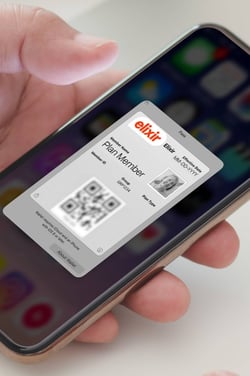
Digitize ID cards for easy access. In a 2023 survey on mobile wallet use, 38.5% of U.S. consumers said they store their health insurance card in a digital wallet. In the same survey, 35.8% of customers said they keep their auto insurance card there.
This is actually one area where insurance companies are falling behind. In 2025, only 55% of insurance customers said their providers “always or almost always” communicate with them on their channel of choice (down from 60% in 2024). Astonishingly, 14% of customers said their insurance company rarely or never communicates with them through their chosen channels.
You can’t control customer preferences, but you can adapt to them.
Modern insurance customers expect flexibility in how they receive information: Some want print, others choose email or mobile apps, but most have a mix that fits their specific preferences (only 15% of insurance customers want a fully digital experience). Limiting communications to one channel risks missing your audience — or worse, frustrating them.
More than half of survey respondents said they prefer online fillable forms like Docusign that they can submit digitally. In insurance, it’s even more important: 77% of insurance customers surveyed said it’s important that insurance companies offer digital data collection options (like fillable forms) instead of making them print, scan, or mail forms.
Modern CCM systems let you use templates to make sure the message is consistent across formats — whether that’s a printed policy packet, an email, or an SMS alert — and send them across multiple channels, so teams don’t have to recreate content for .pdfs, emails, and webpages. That means less time spent on fiddling with formatting and more time focusing on customer needs.
Tip 4: Send correspondence faster and react to customer behavior
When customers request a change or file a claim, they don’t want to wait days for a response. Customers expect claim updates faster than ever — within 24 hours, by some estimates — and they want their policy changes to be processed as soon as digitally possible. Quick, accurate communications help ease stress and strengthen trust.
Speedy communications are often constrained by hangups on the operations side. If there are delays in data updates, your communications will always lag behind. Learn about the importance of choosing the right customer data integration approach to make sure your CCM can help you send responsive, on-demand comms.
-
Stop relying only on data batches or scheduled output. Most traditional CCM systems rely on a cadence of data exports, like nightly flat files that contain the data used to personalize and send comms. There’s always a place for batch comms (annual mailings, policy statements, etc.), but when you don’t have real-time access to data, you can’t respond quickly to customer behavior or requests. You also can’t guarantee that the information the customer sees is accurate and up-to-date, which can lead to trust-killing inconsistency across channels.
- Here’s how Elixir enabled real-time response for a leading organization, helping them streamline application, payment, and customer service through a popular social media messaging app.
- Automate document generation. Use pre-approved templates for common types of correspondence, along with content personalized using up-to-date customer data, instead of spinning up new content for each document.
-
Speed up review cycles with workspaces, roles, and rules-based workflows instead of email chains and conflicting feedback. Modern CCM solutions like Elixir Cloud make it easier to get documents approved for production with configurable review rounds, approvers, and permissions. Having those workflows defined and centralized in your CCM platform, rather than scattered across different tools and departments, helps reduce errors and delays in getting comms out quickly and accurately.
Tip 5: Make it easy for your teams to work together on customer communications
-
Use CCM tools with real-time collaboration, rather than splitting different essential customer comms workflows across separate tools and systems.
-
Let business users create, edit, review, and approve correspondence in one place, rather than bottleneck new documents and updates with the IT team.
-
Use tools with built-in version control to manage changes and automate logging for audit trails.
CX as a discipline is often split across separate teams like IT, operations, marketing, security, and compliance. A 2022 Forrester survey found that the distribution of CX initiatives across departments presents challenges like differing priorities (32%), different needs for different teams (37%), and a lack of a cohesive CX strategy tying them together (25%).
Almost half of Harvard Business Review survey respondents said a lack of collaboration across teams gets in the way of quality customer interactions. To tie it to business impact, 38% of companies said they’d lost customers specifically because of poor collaboration inside their organization.
Rather than spread common insurance CX workflows across disparate systems and tools, modern CCM products give you a centralized platform to manage customer communications. Being able to create, review, personalize, deliver, and analyze with other teams in one place lets you take a more thoughtful, intentional approach to insurance comms that can increase engagement and trust.
Tip 6: Use AI responsibly — and be ready to prove its value
-
Assess your organization’s appetite for risk. Some surveys show that companies in regulated industries are more hesitant to adopt AI than companies in other industries due to compliance regulations and privacy concerns around personally identifiable information (PII) and personal health information (PHI).
-
Define your ideal use cases for AI and how you’ll measure its effect. Base these around the areas of greatest opportunity in your CX (efficiency, accuracy, etc.), rather than ‘adding AI’ before finding out what to do with it.
-
Be honest with customers about how you use AI — and how it benefits them.
It’s 2026, so I’d be remiss if I didn’t mention AI when writing about customer experience. A lot of CX leaders we talk to ask if they should be using it in their communications. We think AI could have a great, positive impact on the relationship between insurance companies and their customers.
While AI has been billed as a revolution for CX, the fact is that customers have a strained relationship with AI in insurance. And we think insurance companies should be very skeptical of the promises of the AI hype cycle.
First and foremost, insurance customers don’t really trust that AI really benefits them. In a 2025 J.D. Power survey, 68% of customers said they think the insurance company benefits most from the use of AI. If you plan to use AI for customer engagement, you should be ready to explain to customers how your use of it helps them — or you’ll risk decreasing their trust in you and your brand alongside it.
In 2026, we recommend that insurance companies thoroughly research and choose practical, proven ways to integrate AI into CX — like using AI to migrate your customer comms content to a modern solution, simplifying content for plain language readers, tagging correspondence for accessibility, and more.
Check out our webinar with Aspire CCS, where our Global VP of Product Libby Koehn put a reality check on using AI for key elements of CCM workflows.
If you’d like to know more about our opinion on the place of AI in customer communications management, our DevSecOps director actually wrote a white paper all about how companies in regulated industries can use AI responsibly — without buying into the hype.
Tip 7: Track what’s working (and what’s not)
-
Use dashboards and reports to visualize data. Set up purpose-driven dashboards that display information relevant to the different groups that contribute to your CX (like event and log monitoring for IT teams, or delivery and engagement stats for marketing and member comms teams).
-
Monitor delivery success and failure rates.
-
Monitor engagement metrics like opens, clicks, and response rate.
-
Look for patterns and gaps that can guide future improvements.
Taking stock of the current state of your customer engagement in insurance is the best way to find ways to improve it. Modern CCM solutions can connect to your preferred analytics platform for deep insight into the customer journey.
How a CCM platform makes better customer engagement possible for insurance companies
If you’ve read all of these tips and aren’t sure your company’s ready to do all of these things — or maybe any of them — you’re not alone. A 2025 insurance market survey found that 46% of insurers can’t keep up with market changes because of legacy tech, and 70% of the average insurance company’s IT budget is spent just keeping the old systems running.
No matter where you’re at in your modernization journey, from ‘just one more season’ to ‘transformation-ready,’ a modern CCM solution can help you catch up to customer demand, create better experiences, and increase trust. Elixir Cloud’s robust core features and value-adding extensions put true modern comms within reach, meet today’s needs and opening up new CCM use cases.
Here’s how Elixir Cloud maps to all of the tips we shared in this blog:
-
Make every single communication easy to understand: Elixir Cloud’s low-code, drag-and-drop designer helps teams of all skill levels create easy-to-understand comms faster. Extensions for document accessibility (like alt tagging, document structure, and color/contrast) help insurance companies create and update compliant, easy-to-read comms without needing to loop in IT or wait weeks for changes.
-
Personalize insurance communications based on customer data: Elixir Cloud’s template design and robust API mean insurers can pull from multiple data sources to personalize correspondence at scale. It means you can send personalized comms on demand, set up event-based triggers, and activate comms workflows to respond to changes in customer behavior — all making it easier to send the right message to the right person at the right time.
-
Deliver correspondence across your customers’ preferred channels: Build templates for comms that can reach customers wherever they want. Deliver insurance correspondence by email, SMS, WhatsApp, and more; integrate Docusign for smooth eSignature form fills; and deliver comms as machine-readable JSON output to ensure a consistent experience across channels like customer portals.
-
Send correspondence faster and react to customer behavior: Elixir Cloud can ingest customer data from your data source in near real-time — unlike legacy tools that rely on batch exports and schedules. With Elixir Cloud, you can send personalized comms at virtually any volume on demand with accurate, up-to-date data.

-
Make it easy for your teams to work together on customer communications: Elixir Cloud's configurable workspaces, collaborative tools, role-based permissions, built-in review cycles, and automated version control mean you can get everyone using the same tools in the same place for insurance communications.
-
Use AI responsibly: Elixir Catalyst uses a proprietary AI to recreate your existing documents in our cloud-native platform, smoothing out your path to modern CCM infrastructure. That cuts down on the lengthy implementation stage of CCM modernization without exposing customers’ PII and PHI. Our API-first approach to integration makes it easier, safer, and more cost-effective to use AI in your CCM, instead of falling into the risky, expensive AI hype cycle.
- We're constantly bringing new, value-adding features to Elixir Cloud, including AI-powered capabilities that address real customer pain points and use cases. Keep an eye out for announcements.
-
Track what’s working (and what’s not): Elixir Cloud’s real-time dashboards give teams the job, delivery, and engagement information they need to make smarter comms decisions. Elixir Cloud’s integrations with the rest of your CX tech stack open up even deeper insights to enrich your customer comms.
Get a demo of Elixir Cloud for insurance comms to see how modern CCM can help you improve your customer engagement.
